
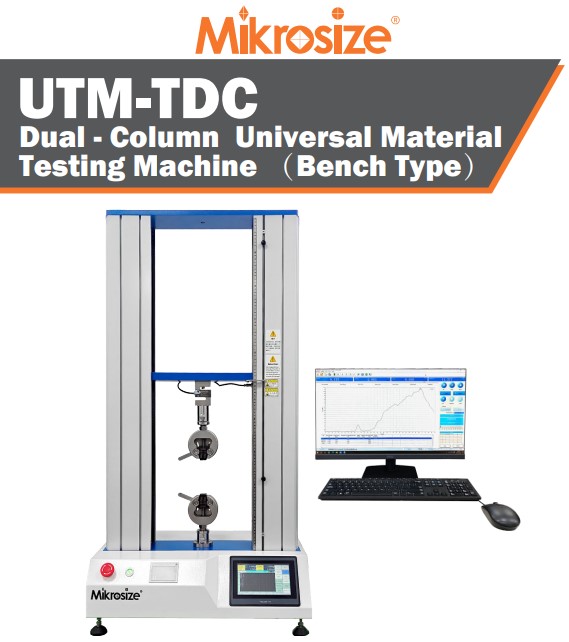
Product Features:
- Color touch – screen for easy and convenient operation.
- Can be connected to computer and used with software for more functions.
- Driven by a stepper motor.
- Class 1 testing machine.
- C3 – grade high – precision load cell.
- Gantry – type dual – column high – rigidity design for durability.
- Maximum capacity: 10KN.
- Test speed:Maximum 500mm/min,Minimum 0.1mm/min.
- Multiple units available:Force: g、Kg、lb、N、KN;Displacement:inch、 cm 、 mm.
- With the function of automatically returning to the initial position after the test.
- In addition to the standard tensile fixture, other types of fixtures can be customized.
- The software provides curve graphs, data tables, and test reports, all of which can be printed.
- Automatically calculates maximum force, minimum force, average,force, maximum deformation, elongation rate, strength, etc.
- With multiple curve modes such as stress – strain, force -displacement, force – time, and strength – time.
- With test mode functions for tension, bending, compression,tearing, peeling, elongation rate, etc.
- Equipped with multiple protection devices including mechanical travel switches, emergency stop switches, overload limit protection,and break – point stop protection.
- Standards complied with:GB/T 2611、GB/T 16491、GB/T 1040、ISO 527、GB/T 8804、GB/T 9341、GB/T 12160、GB/T 16825
Product Applications:
- Manufacturing industry: Used to test the mechanical properties of various parts and raw materials to ensure product quality meets design requirements.
- Material research and development: Helps researchers understand the mechanical properties of new materials and provides data support for material improvement and innovation.
- Research institutions: In scientific research experiments, it is used to study the mechanical behavior laws of substances and promote the development of related disciplines
- In the process of mechanical processing, Brinell hardness tester can be used to detect the hardness of raw materials, in order to select suitable processing technology and cutting tools.
- Can be used to test the hardness of mechanical components such as gears, bearings, bolts, etc., to ensure that they meet design requirements and performance requirements.
- Can be used to test the hardness of forgings to determine the effectiveness of forging processes and the quality of forgings.
